
Climate Pathfinder: Finding Solutions Within the Grid
The key question that the GRACE team attempts to solve is, with the infrastructure we already have, could we run a “smarter” grid by analyzing, understanding and reconciling uncertainty and modeling it?
“What we are trying to do is not look at one possible future.
Dimitris Floros
We are looking at many possible futures.”
“What we are trying to do,” Floros explains, “is not look at one possible future. We are looking at many possible futures. We’re not working on the average or the expected, but also on the tails of the distribution.”
Human Behavior Matters
Those “tails” are where trouble resides: holiday demand spikes, heat waves that push air-conditioning loads, storms that take out transmission lines, or weather patterns that knock down both solar and wind at once. Rolling blackouts in the Duke Energy territory during the winter of 2022 were a concrete reminder of the issues. Using only weather data, models couldn’t fully explain the demand spike.
“Weather is not enough to paint a picture,” Floros says. “Human behavior matters too.”
Just by changing how we operate the grid, emissions can drop in the near term while new clean capacity is built, said Floros. For example: how we schedule generators, how we use storage, and how we anticipate those low-probability, high-impact events can make a difference.
Long-duration energy storage also plays a central role. Today, typical grid operations rely heavily on reserves of energy: When you’re not sure what demand or generation will look like tomorrow, you simply keep a lot of extra capacity online. But it’s expensive, it’s imperfect, and it doesn’t always protect against the right risks.
“Distributed energy storage really helps,” Floros says. “You can always use storage to hedge against errors and to anticipate what happens.”
Duke’s research expertise in climate finance and policy led to other opportunities. An evolution of the GRACE work, Duke's Nicholas Institute for Energy, Environment and Sustainability brings together modelers such as Floros with lawyers, market experts and policy scholars to answer a pressing question: How can massive new loads — especially AI driven data centers — connect to the grid without wrecking reliability or affordability? The team is testing how “load flexibility” and new market rules could allow those facilities to shift usage, rely on on-site storage, or otherwise become partners rather than pure stressors on the system.
Climate Runs Through Everything
Floros’s research in the Patino-Echeverri lab has also led to his participation in the new corporate startup GridSeer. Led by Duke Professor Jesko von Windheim and Patino-Echeverri, Gridseer translates models for decision-making under uncertainty to commercial and industrial electricity customers.
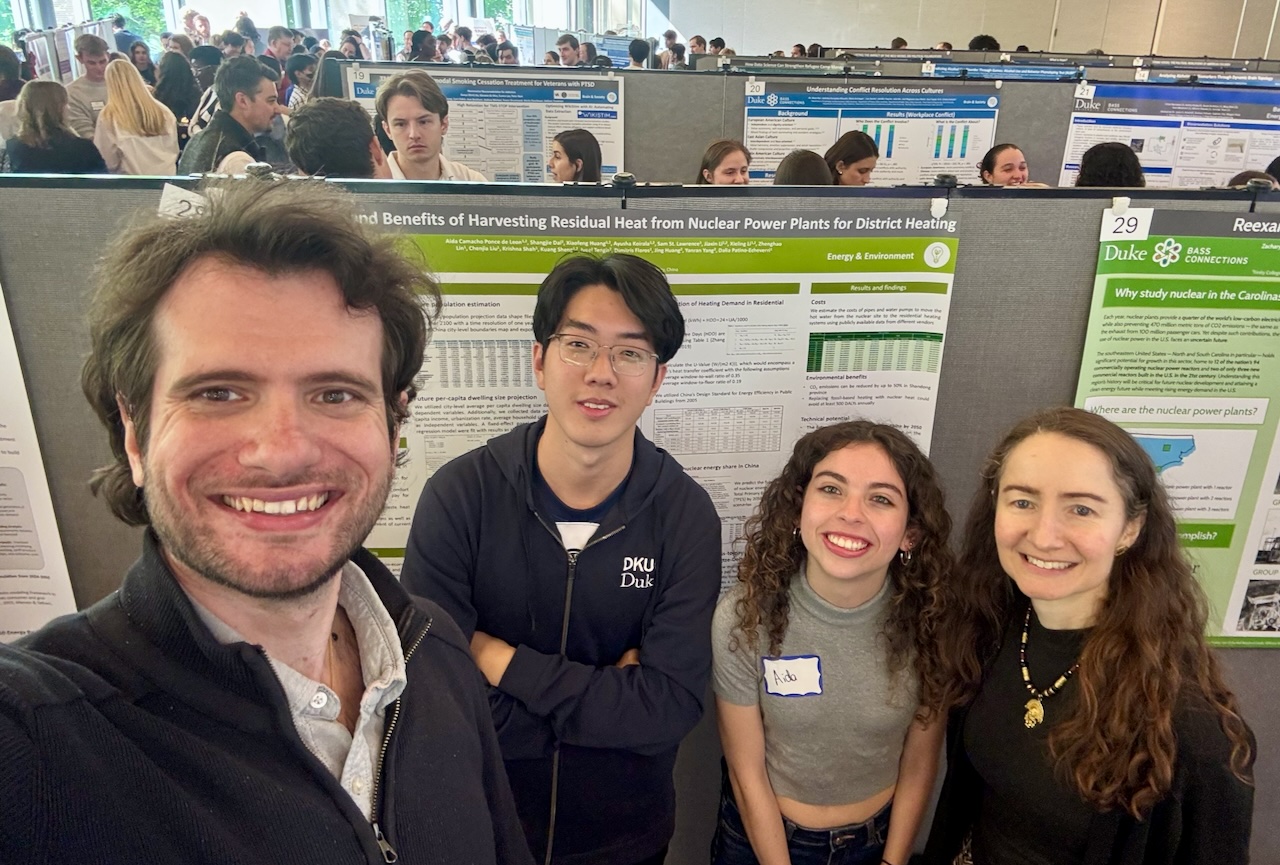
At Duke, Floros has also made an impact through his teaching. He co-teaches a systems modeling course with Patino-Echeverri and helped lead a Bass Connections project on re-using waste heat from nuclear plants for district heating.
“It feels like this climate commitment really runs through everything,” Floros says. “Teaching, research, campus operations — there is always something that reminds us we need to help the environment in some way.”
Scaling Up
Duke University has received $10.45 million in the form of a new award and donor pledges to launch a one-of-a-kind, climate-focused program for postdoctoral fellows.
Scholars for Climate and Advanced Leadership in Environment and Sustainability (also called SCALES) will recruit outstanding early-career scholars to Duke to advance breakthroughs in climate challenges through research across Duke’s 10 schools.
That can be as small as a sticker by the elevator nudging you toward the stairs if you are able, or as large as a campus-wide conversation about data centers and grid reliability. For Floros, it also meant unexpected exposure to perspectives from policy, health and business that now shape how he frames technical questions.
“There are all these random chances in life that just create amazing opportunities," Floros says. “It has been a wonderful journey so far — and a very unexpected one.”
Read more about other students in the Climate Pathfinder series.